
Picking a Settlement Mode Before the Racks Arrive
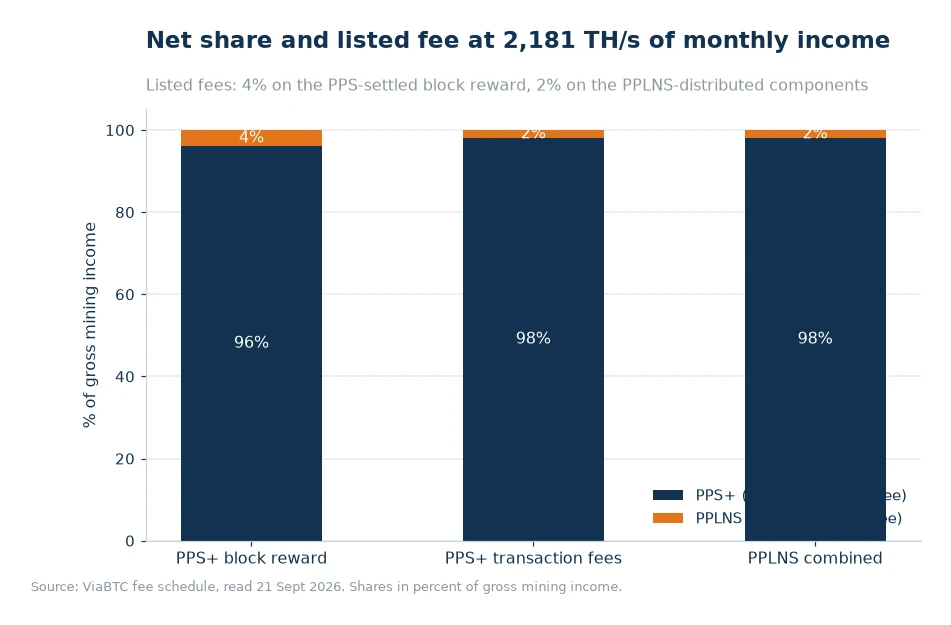
The settlement mode is the last thing most buyers think about and the first thing that shapes their cash flow. At 2,181 TH/s the daily gross is $82.86; PPS+ takes a listed 4% on the block-reward component, or $3.31, while PPLNS takes a listed 2% on the combined total, or $1.66. Deciding between them before the machines ship is easier than switching later.

Key takeaways
- At 2,181 TH/s, PPS+ charges $3.31 a day on the block reward and $1.66 on the fee component; PPLNS charges $1.66 on the combined total.
- PPS+ credits hourly against current difficulty, while PPLNS waits for six confirmations.
- A 2% difference in listed rate is worth about $1.66 a day at this hashrate, roughly $49.80 a month.
- Choose on timing and variance first; the rate difference is the smaller part of the decision.
Why the choice belongs in the purchase plan
Ordering hardware is a sequence of commitments: power capacity, rack space, cooling, network drops, and a pool account. The settlement mode belongs in that list because it determines how the first invoice after commissioning gets paid. Buyers who leave it to the default and revisit it in month three tend to discover the timing mismatch at the worst possible moment, usually while a deposit is due.
There is also a modelling reason. Every projection made before delivery uses one of two assumptions: steady hourly credit, or a lumpy credit that averages out over weeks. Mixing the two in a single spreadsheet produces a cash-flow curve that matches neither mode, and the error is invisible until the first month closes.
Hourly credits versus a six-confirmation wait
Under PPS+ the block-reward component settles hourly against current difficulty. That is a strong property for anyone paying weekly or monthly bills: the pool credit and the calendar advance together. The listed 4% on that component is the price of not carrying pool luck, and at this hashrate it works out to $3.31 a day.
PPLNS is a different clock. The block reward and the transaction fees are combined, the block waits for six confirmations, and the miner's slice is measured across the last five difficulty rounds. The payout therefore arrives after the chain settles and reflects a window rather than an hour. The listed 2% on the combined total is $1.66 a day here, and the lower rate is compensation for accepting that timing.
Two modes side by side at 2,181 TH/s
The comparison that matters fits in four rows. Anything longer belongs in a separate document about taxes.
| Criterion | PPS+ | PPLNS |
|---|---|---|
| Block-reward rate | Listed 4% | Listed 2%, combined |
| Transaction-fee rate | Listed 2%, PPLNS logic | Included in the 2% |
| First credit | Hourly, current difficulty | After six confirmations |
| Variance carried | Pool, not miner | Miner, over five rounds |
Read the first two rows together and the "six percent" myth dies on the spot. Read the last two and the actual trade appears: a smaller listed deduction in exchange for waiting and for absorbing swings. Neither row is a hidden cost. Both are visible on the ViaBTC Pool Fees page, which is worth opening before the purchase order rather than after.
Cash flow, not just cost
Run the numbers as a schedule. At $82.86 gross a day, PPS+ puts roughly $3.31 a day into the fee line and credits the remainder as it accrues. PPLNS puts $1.66 a day into the fee line but may credit several days at once, after confirmations. Over a quarter the totals converge; within any given week they do not.
If a deposit, a loan repayment or a rent cheque falls due on the fifth of the month, the convergence is irrelevant and the weekly path is everything. A farm that needs predictable dates should pay for predictability. A farm with six months of runway can afford to wait for the lower rate and let the swings average out.
The variance trade most people misread
New buyers often hear "PPLNS is cheaper" and stop there. The lower listed rate is not a discount on the same product; it is payment for accepting a different distribution. Over a long window the average may be higher, but any single window can sit below the PPS+ line, and a small farm feels that in a way a large one does not.
The honest framing is insurance. PPS+ is a premium paid for a flat line. PPLNS is the uninsured version with a lower premium. Neither is smarter in the abstract; the answer depends on whether a bad fortnight would force a sale of hardware or a missed payment. If it would, the premium is cheap.
Writing the choice into the plan
Put the mode in the same document as the delivery date, the power budget and the expected hashrate. Then add two lines: the assumed daily credit and the assumed first-credit date. When the machines arrive, compare the first week against those two lines. If the mode is PPLNS and no credit has landed by day three, that is expected rather than broken, and the plan should say so in advance.
It also helps to name the fallback. If cash gets tight after commissioning, a Collateral-Pledged Loans position can bridge a settlement gap without selling machines at a bad moment, though borrowing costs belong in the same ledger as the fee and should be counted before the position is opened, not after.
One more line worth writing down is the exit. Machines bought for a two-year run may be sold in fourteen months, and the settlement mode affects the resale decision more than it affects the daily rate. A farm on PPLNS that has just had a strong window looks healthier on paper than it will on the day the hardware changes hands.
Worked example
Follow the 2,181 TH/s case from hashrate to the two fee lines.
- Gigahash: 2,181 TH/s = 2,181,000 GH/s.
- Network share: 2,181,000 ÷ 1,003,107,267,295 = 0.0000021742.
- Daily coins: 0.0000021742 × 450 = 0.00097841 BTC.
- Gross dollars: 0.00097841 × 84,692 = $82.86.
- PPS+ block-reward line: 82.86 × 0.04 = $3.31.
- PPLNS combined line: 82.86 × 0.02 = $1.66.
- Daily difference between the two modes: 3.31 − 1.66 = $1.65, or $49.50 across 30 days.
That last line is the whole decision in dollars, and it is smaller than most buyers guess. Fifty dollars a month does not justify a mode that creates a cash crunch. It does justify the lower-rate mode for an operator with a reserve and no fixed payment dates.
Frequently asked questions
Can I change settlement mode after the machines arrive?
Yes, the mode is an account setting rather than a hardware constraint, but the first days under the new mode will not match the old cash-flow pattern, so change it between billing cycles rather than in the middle of one.
Which mode is better for a first farm?
Whichever matches the payment dates. A first farm usually has tighter cash than it expects, and the hourly credit under PPS+ costs $3.31 a day at 2,181 TH/s for a flat line that is easier to plan around.
Does PPLNS pay less over a year?
Not necessarily. The listed rate is lower at 2%, and the average can come out ahead, but the result depends on the mining window and on pool luck, which the miner carries rather than the pool.
Decide once, then measure
Write the decision down with a date and one number to check against it: the first credit. After thirty days, compare the actual credit with the projection built from the Profit Calculator at commissioning hashrate. If they differ by more than a couple of percent, find out why before changing anything else. Most gaps are uptime or a stale difficulty input, not a settlement mode doing something unexpected.
Sources: fee schedule, calculator and lending pages on viabtc.com. Read on 21 Sept 2026: difficulty 132.76 T, network hashrate 1,003 EH/s, BTC $84,692, and 144 blocks a day paying 3.125 BTC each[1]. Comparisons assume the hardware never idles. Published 24 Oct 2026.